
5 min reading time, Updated on May 4, 2026
ActiveDB & AAS: Dynamic Digital Twins Based on the IDTA Standard
Digital twins have long been more than just a concept.
They are becoming the cornerstone of scalable, data-driven business models.
With the Asset Administration Shell (AAS), the IDTA has created a standard that defines how digital twins can be structured and exchanged.
ActiveDB goes a step further:
It fully supports the standard—and turns it into living digital twins that are actively integrated into processes.
Content
After reading this article, you will know:
The Standard: IDTA Defines Digital Twins
The IDTA clearly describes how a digital twin is structured:
The goal is clear:
Interoperability across system and organizational boundaries
However, in practice, it becomes apparent that:
The standard defines structure and data exchange — the platform enables operational use during ongoing operations.
ActiveDB adopts the structure of the AAS—but expands it into an operational system.
As a result, a digital twin is not merely described, but:
ActiveDB thus defines living digital twins.
Compared to a standard IDTA definition, ActiveDB offers advanced capabilities:
The result:
A digital twin evolves from a mere description into an active component of the system architecture.
This applies to AI as well.
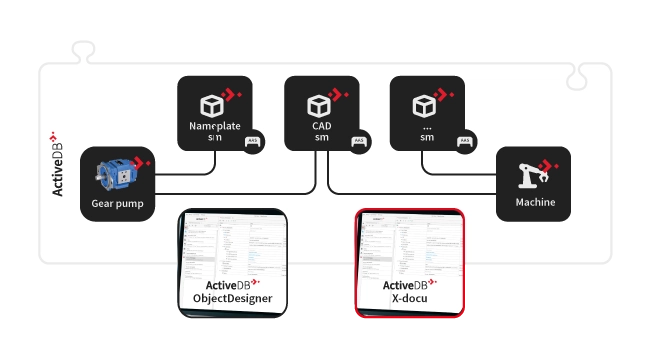
ActiveDB remains fully compatible with the IDTA AAS standard:
This ensures:
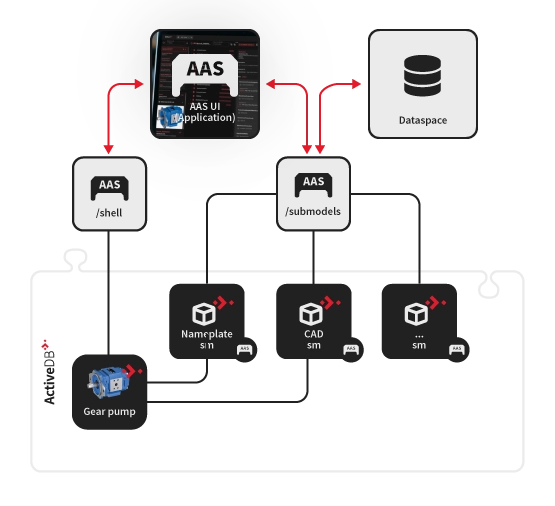
More than just a repository: A complete AAS implementation
ActiveDB implements not just individual components, but the entire infrastructure:
This creates a system in which living digital twins can be fully utilized.
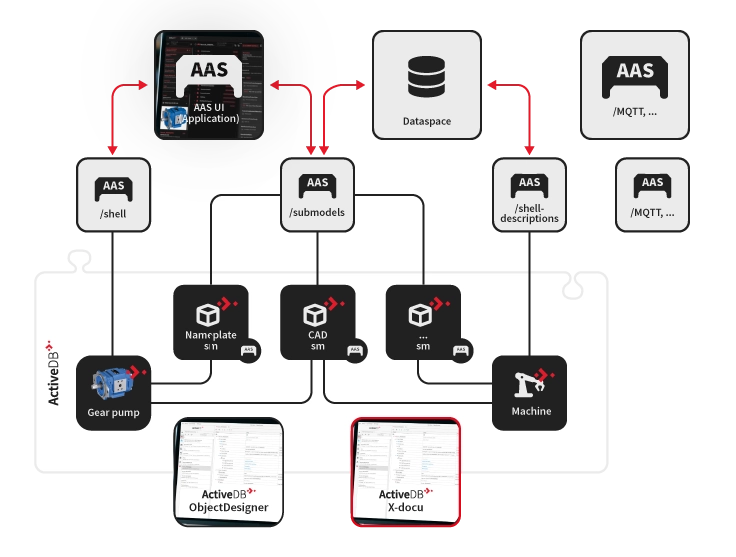
The IDTA AAS lays the foundation for digital twins.
ActiveDB turns this into a system ready for real-world use.
Dynamic digital twins powered by ActiveDB are:
This transforms a data model into a true value driver for digital business models.
This helps companies avoid:
It’s not the technology that’s the limiting factor—it’s the architecture.
This is exactly where bill-X comes in:
Du brauchst eine unkomplizierte Schnittstelle und suchst noch einen Partner? Oder ist dein Projekt eher komplex und dein Vorhaben schwierig? In beiden Fällen – perfekt.
Nutze das Kontaktformular oder schreibe uns einfach eine E-Mail.
Unsere Kontaktdaten:
bill-X GmbH
Liebigstraße 29
D-49074 Osnabrück
+49 541 71008-0
info@bill-x.de
Nutze das Formular oder schreibe uns einfach eine E-Mail. Wir freuen uns auf Deinen Besuch an unserem Stand.
Unsere Kontaktdaten:
bill-X GmbH
Liebigstraße 29
D-49074 Osnabrück
+49 541 71008-0
info@bill-x.de